Showing posts with label culture. Show all posts

Thursday, November 21, 2013

Xocolata Amb Xurros (Chocolate with Churros)

Kilian and I went out for the most sugar-filled breakfast imaginable: xocolata amb xurros.
Xurros with lots of sugar!

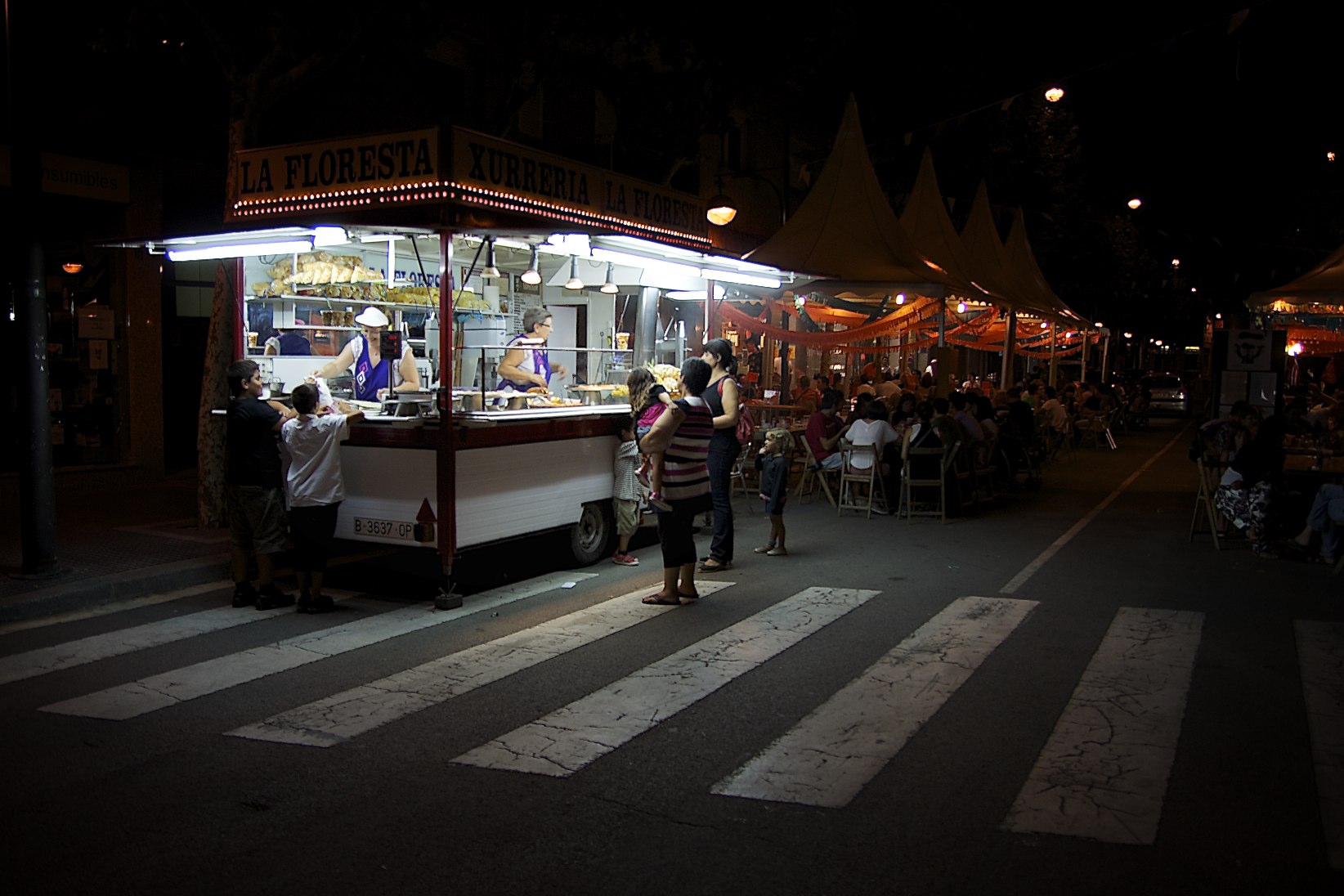
When the weather turns to autumn, xurro trucks, xurrerias, begin to pop up in different places around Catalonia. These trucks serve freshly deep-fried xurros, which are different from porras, which the Catalans seem to love (according to Wikipedia, this is most popular in Spain and Italy).

Xurreria at night, courtesy of Flickr
The first time I heard about churros was in my middle school Spanish class where we learned about "Mexican" food, including churros. We had a celebration where we could try these desserts, along with a variety of other typical eats. Those churros from the States are not the xurros of Catalonia. These ones are markedly softer, served fresh and warm with hot xocolata desfeta (melted chocolate), a very dense, dark, rich hot chocolate beverage.

As I mentioned before, this meal is served at breakfast. I'm not sure I would call it a meal; to me it is more like a dessert. But this is typical here and when in Catalonia, do as the Catalans do, or so they say.

Xurros are the small and thin ones. Photo from: CocinaRecetas)
Having tried xurros from different places, I find that there can be a huge difference in taste and texture depending on a number of factors including how long they are fried for, the dough, and the amount of oil/sugar ratio when served. For me, overly oily xurros are too much for my stomach to bear for very long.

The type of xocolata also makes a difference. Since there are both milk chocolate and dark chocolate variations of xocolata desfeta, this contributes to the richness of the meal, as well as the consistency of the xocolata desfeta. A more liquid xocolata will go much further than the thick, pudding-like kind which is heavy in and of itself but a very rich dark chocolate won't make it as long (for me and my tummy) as a less intense milk chocolate.
Milk chocolate (left), xurros, dark chocolate (right)
This combination is very heavy and sweet; not for the faint of stomach. Eaten with moderation, it makes for a quite delicious breakfast or afternoon snack.

Wednesday, October 30, 2013

The Castanyada: a Catalan alternative to Halloween

Every year on the eve of All Saints Day, which happens to also be Halloween for America, Catalans celebrate the "Castanyada," a dinner of sweet potatoes, roasted castanyes (chestnuts) from which the word "castanyada" is derived and panellets (almond-based cookies). It is traditionally served with a special wine. This Catalan holiday differs from many others in that it is celebrated in the home with family over dinner rather than in the streets with music, dance and other activities.
Sweet potatoes, chestnuts and panellets
Enjoying the Castanyada dinner with family

A large selection of panellets.
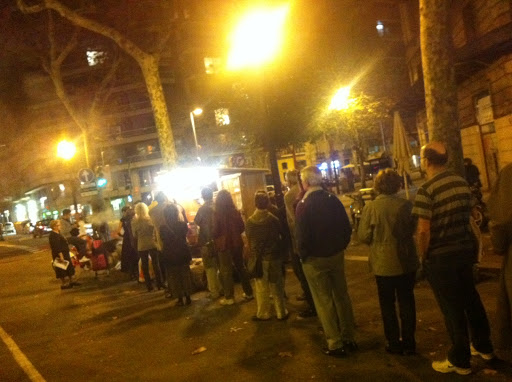
During this time of the year, walking through Barcelona and surrounding towns, one will find street vendors roasting chestnuts and sweet potatoes where long cues form to get their hands on these sweet and healthy treats. Since the weather drops quite a bit at this time of year, it is a real delight to warm up the body with these piping hot, freshly-roasted snacks.

Anyone in the mood for chestnuts? Photo credit: Barcelona Street Times

The traditional figure from this holiday is the castanyera (the chestnut-roaster), depicted by the image of an old woman in a skirt with apron and a headscarf, bent over a grill. This image is part of the collective memory of the origins of the Castanyada and has been immortalized in popular children's songs as well as through drawings and stories.
Photo credit: L'Elefant Tropeta


Friday, September 27, 2013

Mistaken Beliefs and Taking Responsibility


Lately, I have been thinking a lot about the concept of taking responsibility for one's life and all that it entails. Shoghi Effendi reminds us that:

Each of us is responsible for one life only, and that is our own. Each of us is immeasurably far from being "perfect as our heavenly father is perfect" and the task of perfecting our own life and character is one that requires all our attention, our will-power and energy.

In general, as a concept in society, it seems that people don't realize their own potential or their own power over who they are. It is as if they are just subject to the various forces around them. For example, if someone is mean to them, the assumed appropriate response is to be mean back. This assumption or belief in "an eye for an eye" does at least two things: 1, is that it makes the individual's behavior dependent on the actions of others, rendering them weak and powerless to external forces beyond their control (e.g. someone else's behavior) and 2, it nurtures a sense of entitlement and justification for retaliating.  The person perpetrating the wrong-doing is the one wronged, not the person who receives the bad action and it baffles me that often we see the wronged one commit another wrong in return, the victim of both an external force and the hurt ego.

Another example we often see is within the young people around us who behave in ways that are aligned with what their family, friends, community, teachers say to them or believe about them. Often times, the adults in their life have very low and negative standards for these young people, expecting the worst from them. We then see the youth act out in negative ways which goes on to perpetuate the negative beliefs around them. There seems to be little hope for escaping the cycle and ever more frequently, there are articles about this problematic age group in the media as well as stories of ever more appalling behavior from them.

Both of these examples just scratch the surface on this issue which is based on one or more mistaken beliefs that create negative results in the lives of those who believe in them. In both examples, these beliefs seem to be the result of poor education - people just don't know better and most likely, their parents taught it to them because most likely, they didn't know any better either.

Living life in this way is not living an authentic life and it is not taking responsibility for who you are and who you want to be. The Bahá’í Writings explain:
We must not be content with simply following a certain course because we find our fathers pursued that course. It is the duty of everyone to investigate reality, and investigation of reality by another will not do for us... Ideas and beliefs left by his fathers and ancestors as a heritage will not suffice, for adherence to these are but imitations and imitations have ever been a cause of disappointment and misguidance. Be investigators of reality, that you may attain the verity of truth and life. - 'Abdu'l-Bahá

The beliefs of our forefathers or of those around us do not necessarily reflect the truth about reality or the nature of life. When we continue down a path of believing in ideas such as "an eye for an eye" or "teenagers are rebellious and unruly" we are propagating negative beliefs in our society and culture that are based on fiction. We are doing ourselves, our peers and our children a disservice. To me, this is one manifestation of not taking responsibility.  We can look at some other writings from the Bahá’í Faith to gain insights into what it then means to take responsibility for oneself:

Each human creature has individual endowment, power and responsibility in the creative plan of God. - 'Abdu'l-Bahá

Unto each one hath been prescribed a pre-ordained measure...All that which ye potentially possess can, however, be manifested only as a result of your own volition. Your own acts testify to this truth. - Bahá'u'lláh

Man is the supreme Talisman. Lack of a proper education hath, however, deprived him of that which he doth inherently possess... Regard man as a mine rich in gems of inestimable value. Education can, alone, cause it to reveal its treasures, and enable mankind to benefit therefrom.  - Bahá'u'lláh

The reality of man is his thought, not his material body... the power of thought is dependent on its manifestation in deeds. - 'Abdu'l-Bahá

I charge you all that each one of you concentrate all the thoughts of your heart on love and unity. When a thought of war comes, oppose it by a stronger thought of peace. A thought of hatred must be destroyed by a more powerful thought of love. Thoughts of war bring destruction to all harmony, well-being, restfulness and content. - 'Abdu'l-Bahá

This last writing is of particular importance to this discussion. 'Abdu'l-Bahá says, "Thoughts of war bring destruction to all harmony, well-being, restfulness and content." This concept is not limited to the literal concept of war, but rather any negative thought one might have. Since we know that we can control and change our thoughts and beliefs, we can see an enormous power that rests within each one of us. I may not have the power to change someone else's beliefs, but by changing my own, I can make an impact on the world. And if I change my thoughts, even better since often our thoughts are informed by our beliefs. And if I change both my beliefs and thoughts, which then inform my actions, I'm not only improving my own life, but I am creating positive change all around - in my family, friendships, community, work and society. It's the responsibility of each and everyone of us to take charge of our destinies, of who we are and who we want to be. Rumi says:

Your task is not to seek for love, but merely to seek and find all the barriers within yourself that you have built against it.


Sunday, September 22, 2013

Museu Vil·la Casals - Museum on the life of Pau Casals

Pau Casals (photo credit from Fundacio Pau Casals)

On September 11th, Catalan National Day, we went to visit the Museum Vil·la Casals which is located on the beach a few minutes from El Vendrell. The Museum is situated in a former of home of Pau Casals, one of the most well-known and respected cellists and composers of recent history.

He is Catalan and was born in El Vendrell in a home near the Placa Nova at the center of town, which can also be visited. He is especially noted for transforming the way cello is played, for his commitment to peace and non-involvement in politics, and composing a song which became the anthem for the United Nations.

Although he passed away in Puerto Rico, his remains have been returned to El Vendrell, where he is buried. On Catalan National Day, one of the cultural activities listed in El Vendrell's event calendar, was paying respects to his resting place and leaving flowers.

A visit to the Museum Vil·la Casals will provide you with an overview of his life, which is done via audio/video presentations in each room in conjunction with artifacts preserved from his life. The home itself is located on the Mediterranean Sea and contains beautiful gardens and sculptures. It is not a large museum but well worth the visit if you are interested in history, music and culture.

Museu Vil·la Casals (photo credit: National Geographic)

Friday, September 20, 2013

Catalan National Day

Catalan's have their own September 11th. It dates back to September 11, 1714 - 299 years ago when they were officially conquered by the Spanish king and their social, political and legal systems were abolished. Since then they have fought to maintain their language, identity and culture - against all odds, as it has been systematically repressed for most of that time.

Last year, they commemorated this day in Barcelona where 1.5 million people demonstrated their desire for a voice, which now means wishing to become the next independent state of the European Union. Due to the success of that demonstration, which was peaceful, without incident and resulted in early elections, some associations organized another large event for this year's September 11th.

Known here as the Via Catalana (The Catalan Way), the idea was to create a human chain that would run from north Catalonia to south Catalonia - from the border with France to Valencia. They needed around 400,000 adults (children not included) to sign up to complete this task and that number was exceeded much prior to the day (some papers reported over one million people turned out). The people were told to wear yellow so that in aerial photos, the line could be easily seen. One of the goals was to gain worldwide recognition of the support that exists within Catalonia for a referendum, for Catalans to be able to vote and decide for themselves if they should become an independent political state, separate from Spain.

Due to its political nature, Kilian and I did not participate. We did, however, take a walk through town that day to witness the historic event since the chain traveled through our town. We saw many people wearing the Catalan flag as a cape around their necks, typical Catalan peasant hats and Catalan folkloric giants. There were families, moms wearing their babies and old folks. There was a spirit of joy and excitement - these people are witnessing a sense of unity and solidarity, progress and momentum that they have not experienced in their lives. It is especially sentimental for the older folks, as I have seen in interviews on the television.

After our walk through town, we went home to watch it on TV. It was pretty impressive to see all the people in different parts of Catalonia. There were such large numbers and in many places, rather than looking like one line, it was just crowds of people. Some images from Catalan media can be found here. Many international news sites picked up the story the next day as well such as The New York Times, The Wall Street Journal, CNN, The Financial Times, The Guardian, The BBC, The Washington Post, and many more.

Later that evening, people danced the traditional Catalan circle dance, sardanes, on the Rambla.


Wednesday, September 18, 2013

Calafell's Medieval Market

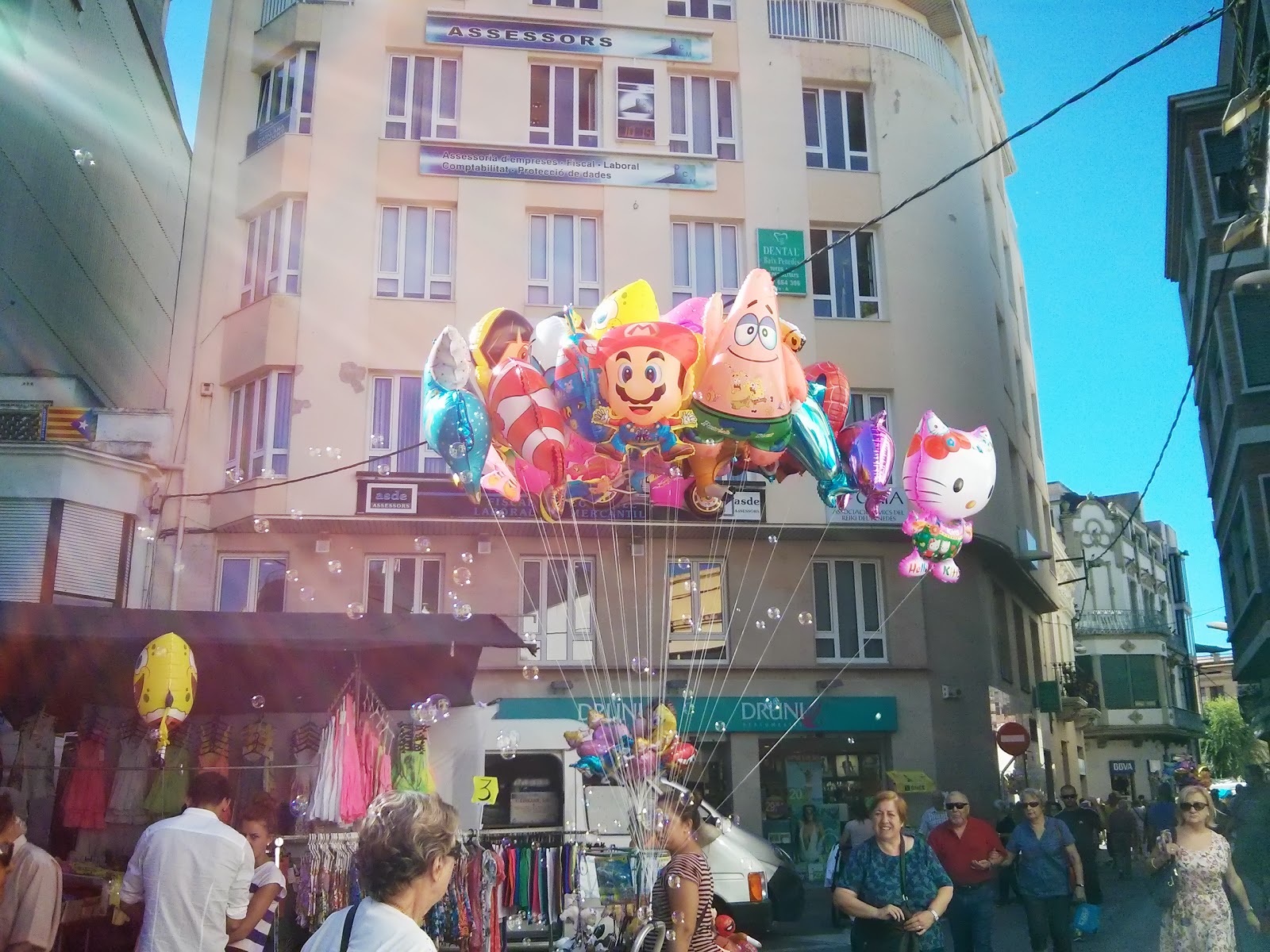
Every year in Calafell, they have a medieval market in the old part of town surrounding the castle. The tiny roads become over taken by booths selling a variety of different things: cheese and meats, artisan crafts, spices and herbs, handcrafted instruments and goods. There is also an abundance of fresh breads and baked foods sold, while meat roasts on large grills. Vendors dress in medieval attire and there are medieval flags strewn throughout. Hay bales are set up as seating at the tables where food is served. There are activities for children such as riding mules and learning pottery.
Castle of Calafell decorated with flags

Playing the instruments of old in the appropriate costumes

Outdoor grill with a selection of meats

Dining area

One view of the market, including large crowds, booths and flags

Mule rides for children

Pottery lesson (so cool!)

Dragon lamp for sale

Wooden shields and swords for sale

Medieval market meets modernity

Eagles for shows at the Islamic area of the market

Fresh herbs, teas and spices for sale

Wednesday, August 28, 2013

The Friday Market

El Vendrell's Friday morning market has all you want and more. From locally grown and fresh from the field produce to clothing and household goods, you can get lost in this market for hours.
Look at those tomatoes and peppers!

Fresh seasonal fruit (and look at all those stands in the background).


Car traffic is blocked for this market.

The Rambla, re-envisioned as shopping district.

Monday, August 26, 2013

Musica a la Vila in El Vendrell

Band from Valencia
For those of you who are interested in visiting Barcelona and getting out of the city for the day, you can easily take the train to El Vendrell. Every Wednesday in August, there is this Música a la Vila festival, where traditional music from the Catalan countries is performed. This is provided free of charge and takes place in one of the town's many plazas.

Every week the music is different and this week we heard a Valencian band play traditional music with hand drum, banjo, cello, flute and other instruments. Pretty awesome.

Friday, August 16, 2013

The Old City of Girona


We arrived early and it was a bit overcast. Nevertheless, it was gorgeous.
We visited the old city of Girona a few weeks ago and it was so colorful and green. It is situated on the banks of a river and somewhat reminded me of Venice. The locals have painted the house these incredibly vibrant and warm shades of red, oranges and yellows.


The town is covered in Catalan independence flags, which was quite a sight, in and of itself.

We only had time for a walking tour - not to enter the city's main sights such as the Cathedral, museum, or enjoy the view from the old city walls but it left such a strong impression that I am eager to go back. Here are a few photos of its charm.

The Cathedral

Details of the Cathedral

A freaking cool modern door.
Walking through one of the plazas, enjoying the shade.

The narrowest of walkways.
Large keys being sold at an outdoor antique market.

Outside the entry of one of the churches, there was this decoration in the cobblestone.

We started climbing the wall but turned back after we realized how far up it is.
The church tower from the walk to to the top.
A door suspended on the city wall. I wonder where those stairs lead.


Monday, August 12, 2013

The Sardana: Catalan Circle Dance

 On Sunday evenings in the summer, the Rambla is cleared of its dining tables and room is made for a stage. This stage will host a band who will play sardana music and the spacious Rambla converts into a dance floor. Young and old alike gather to watch and dance.
The Rambla of El Vendrell with church tower in background.

The sardana is a traditional Catalan circle dance. The participants hold hands in unity and with light movements of the feet and hands, they dance to the rhythm of the music. Watching the sardana dance while listening to its accompanying music generates feelings of peace, tranquility and joy (I loved it so much, we had a professional Sardana group perform at our wedding and show us how its done).

Here's a short video so you can see what it is all about (it gets interesting about one minute in). These folks are in the typical costume.


More photos from our visit to the Rambla to watch Sardanes. I can't wait to learn!
With the band playing sardana music, the circle starts out small...
...then more people are eager to join.
It grows very large; anyone can join.

The Rambla is so beautiful in the summer with the trees in full bloom.